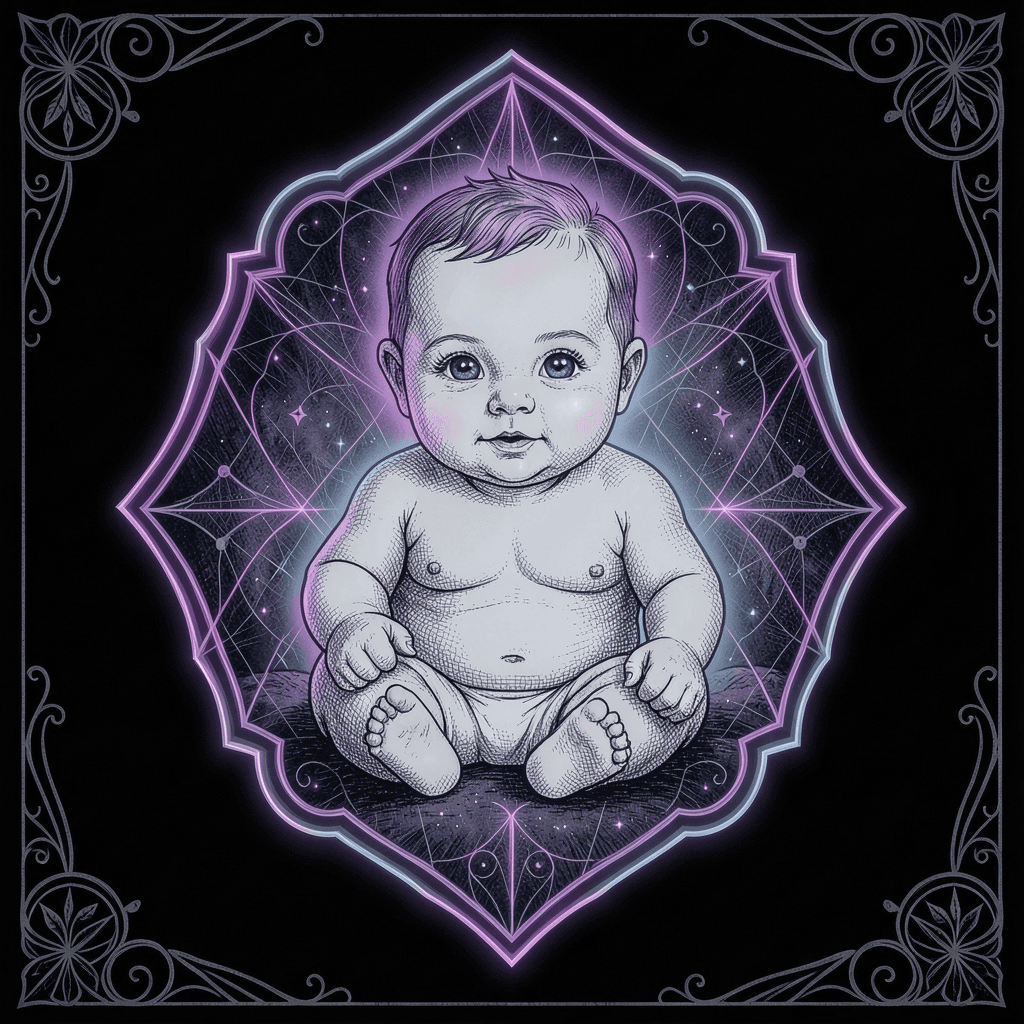
Baby with fangs dream meaning — interpretation
What it means to dream of a baby with fangs: a newborn that bites, smiles, or only shows predatory teeth, and how that differs from an ordinary baby dream or a teeth dream.
Somnovis editorial team
A baby with fangs is a dream image that will not sit quietly inside either of the pictures it is made from. An infant, on its own, is the usual image of something new, fragile, and in need of care — the reading gathered under a baby. Teeth, especially teeth that loosen or fall, are the usual image of potency, family, and the ability to bite into life — the reading gathered under teeth. Put a predator's canines in a newborn's mouth and the two comforts cancel. What has arrived is small and dependent, and it already has a mouth built to wound.
The dream is unsettling for that reason, and the unsettlement is the material, not a mistake in the image. People report a newborn, a slightly older infant, or a baby that is somehow both a human child and an animal at the mouth. The fangs may be milk teeth gone sharp, dog- or cat-like canines, or teeth that simply do not belong in that face. The rest of the reading depends on what the baby does with them, and on whose baby it is.
Something new that is also a threat. The image often hangs on a beginning the dreamer cannot sort into "safe" or "dangerous": a project, a relationship, a pregnancy, a child already born, an idea that has started to have consequences. The baby is the newness. The fangs are the part of that newness that can demand, injure, or turn. The dream does not elect a winner between innocence and danger. It keeps them in one face, which is why waking from it feels like a contradiction rather than like a message with a single line.
Fear of harming what one loves. Sometimes the dread is not that the baby will bite. It is that the dreamer might. Protective feeling around anything helpless often arrives with its opposite: the impulse to guard, and the horror of noticing one's own capacity to hurt the thing one is guarding. A fanged infant can stage that double feeling as a single body. The loved thing already looks like the harm. Picking the baby up, in that version, is not simple tenderness. It is a question about the dreamer's hands.
A dependent situation that has teeth. The baby need not be a child at all. It can stand for a person, a job, a debt, an illness, or a role that seemed powerless and then showed an unexpected bite: a claim, a deadline, a consequence, a need that will not stay small. Ordinary baby dreams worry that the new thing is too weak to survive neglect. This one worries that weakness was never the whole description. Something that still has to be carried has acquired the power to bite the person carrying it.
Variants, and they are not the same dream. A baby that bites has already used the capacity. The demand, the injury, or the shock is happening, not merely visible. A smile that shows the fangs keeps the infant's face and the threat in one expression. The dreamer is being asked to trust a mouth that will not hide its teeth. An attack — lunging, chasing, drawing blood — pushes the picture toward fear of what the new thing will do if it is not controlled. A calm baby with the fangs simply visible is often the least literal of the set: the capacity is seen, and nothing is being done with it yet. That calm can be more disturbing than a bite, because the dream refuses to resolve the danger into an event.
Whose baby, and how the dreamer stands. The dreamer's own child pulls the reading toward parenthood, protectiveness, and the fear of one's own strength around someone who cannot defend themselves. A stranger's baby, or a baby attached to no one, pulls it toward a part of life the dreamer has not yet claimed. A baby that used to be ordinary and grows fangs during the dream marks a change of estimate: something the dreamer had filed as harmless has been reclassified. Whether the dreamer picks the child up, drops it, freezes, or keeps a careful distance is part of the same question. So is the reaction of anyone else in the room. If the other people treat the fangs as normal, the dream is often less about a monster and more about a fact the dreamer is the only one still refusing to see.
What it does not mean. It does not predict that a real child will become violent, and it is not a verdict on the dreamer as a parent or as a person who might become one. It is not a pregnancy omen, any more than an ordinary baby dream is. It is not the teeth-falling dream: nothing here is being lost from the mouth, and the familiar reading of lost potency does not transfer. The inversion is the point. Innocence has been given a bite. The useful question is which new, dependent thing in the dreamer's life already has more force than its smallness suggests — and whether the fear in the dream belongs to that thing's teeth, or to the dreamer's own.
Perspectives across traditions
The classical Islamic dream-interpretation tradition files an infant and a mouth of teeth under different matters, and it does not hand a fanged newborn a single fixed ruling. An infant is commonly read as care, responsibility and worry arriving together: a charge the dreamer must carry, welcome and heavy at once. Teeth are commonly read as kin, and also as the dreamer's own strength and standing. Strong, sound teeth point toward capacity in one's affairs and one's family. Teeth that fall or are lost point toward change among relatives, sometimes toward illness or absence, with the details — which teeth, whether they land in the hand, whether there is blood — moving the severity. A baby that already has fangs sits in the gap between those two files.
The honest use of the tradition is to keep both files open, rather than to invent a third omen the manuals do not carry. Read as a responsibility, the image is a matter the dreamer has taken on that is no longer only fragile. Read through the mouth, the fangs are a capacity to wound that has appeared earlier than a human infant's mouth should allow. A bite weighs the second file more heavily: the charge is already acting. A calm child whose fangs are only visible weighs the first: the dreamer is being shown the force inside a duty that still looks small. Whose child it is matters in the same practical way the classical material lets the owner of a tooth matter. None of this is a forecast that a child will harm anyone. The tradition's interest, here as elsewhere, is the dreamer's conduct toward a charge that has acquired force.
It is also worth saying what should not be imported. The severe family-readings attached to lost teeth do not describe this picture, because the teeth are not leaving. The favourable readings attached to a healthy, quiet infant do not describe it either, because the mouth has been altered. Between those two refusals is the actual reading this tradition can support: a responsibility and a strength have been drawn in the same body, and the dreamer is being asked how they will handle a trust that can bite.
Analytical psychology treats the child as an image of what is new in the personality: potential, futurity, something not yet defended. Its smallness is part of the meaning. Fangs do not cancel that reading. They supply the instinctive half that a purely tender child-image leaves out. Appetite, anger and the ability to bite belong to what is coming into being, and the dream refuses to show the new life without them. The picture is not a monster pasted onto a baby. It is a baby whose future strength has arrived before the rest of it has grown up.
The feeling on waking decides the emphasis, and a single rule would flatten it. Horror at the mouth often belongs with the dreamer's own aggression, recognised inside something they want to protect. The capacity to harm is wearing the face of what they love, which is a harder meeting than an obvious enemy. A calm infant with the fangs merely visible is closer to a capacity that has been seen and is not yet acting. A bite or an attack is that same capacity already turned outward, toward the dreamer or toward someone else in the room. Whose baby it is asks whether the dreamer has owned this new force or is still meeting it as a stranger's problem.
A Jungian reading does not turn the picture into a fixed symbol-to-meaning entry, and it should not be told as one. It asks which part of the dreamer's life is both too young to stand alone and already sharp enough to hurt — a project, a bond, a role, a dependent person — and whether the dreamer's response in the dream was care, flight, or the frozen wish that the teeth would turn out not to be real.
Chinese folk dream material treats a child and a set of teeth as separate entries, and an infant with a predator's fangs is not a stable manual line of its own. That absence matters. The tradition is full of specific rulings, and where it has no ruling, the honest article says so instead of coining one that merely sounds like a proverb. Children are read inside the household. One strand takes a healthy child as continuity and good prospects for the family. The manual strand is less sweet: readings of the shape that a child portends quarrels, that holding a child portends a happy event, that a crying child portends words and dispute. The tradition carries both and does not tidy them into one mood. Teeth are another file. Falling teeth are widely tied to elders and to the family, and teeth that grow in are read more favourably, as growth in the household or in the dreamer's own prospects.
Fangs on an infant borrow the shape of the child-entry and then put a hunting mouth on it, which neither file states as a single omen. The useful reading is the collision, held as strands. Where the child-strand is loud, the dream is about something new in the household that will not stay merely gentle: a beginning, a dependent, a matter that still has to be carried and will not remain only sweet. Where the tooth-strand is loud, the dream is about a capacity — speech that cuts, a demand, a bite — showing up in a body that still needs to be held. A smile that shows the fangs keeps the auspicious face and the warning in one expression. A bite moves the picture toward the quarrel-strand already present in the child entries. An attack makes that strand the whole scene.
Nothing in this authorises a claim about a real infant's character, and the gap should not be patched with a set phrase invented to cover a picture the manuals did not list. The contrast with an ordinary baby dream, and with the falling-teeth dream, is the point of having both pages: this image is what happens when the household's smallest figure is no longer only small.
Sources
The tradition sections draw on these works. That is not a claim that every sentence is a quotation from them. Authorship of the treatise attributed to Ibn Sirin is disputed. The Chinese dream manual is paraphrased: its wording differs by version, so no edition, chapter, or date is named.
- Artemidorus of Daldis, Oneirocritica (2nd century).
- Muntakhab al-Kalām fī Tafsīr al-Aḥlām, the dream book attributed to Ibn Sirin.
- Zhou Gong Jie Meng (周公解梦).
- C. G. Jung, Man and His Symbols (1964), and the Collected Works.
Was your dream different?
Tell us exactly what you saw — our deeply trained AI will work through every detail and nuance of your specific dream.
Get a personal reading